Malaysia's Tenth Prime Minister

Malaysia's Tenth Prime Minister
YAB Dato' Seri Anwar Ibrahim

Saturday, March 26, 2016

From the archive of Sarawak Report 11th May, 2013

Quite Right To Fight!

11 MAY 2013
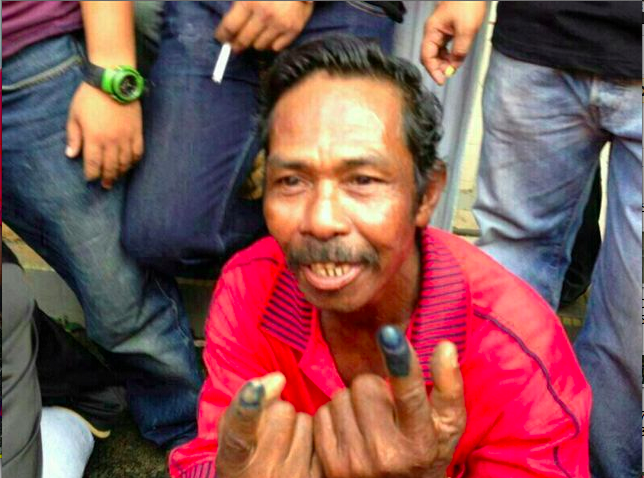

Symbol of BN’s GE13 election ‘win’?
BN should not expect Pakatan Rakyat to take their version of GE13 lying down.
After all Pakatan represent the majority of the voters by a very substantial and convincing margin!
Even after all the jiggery pokery with the electoral register, the bus loads of phantom voters, the mysterious additional ballot boxes that arrived during re-counts, the double voting that excluded numerous rightful voters from being able to cast their ballots, Pakatan gained almost 8% more of the votes in Peninsular Malaysia.
53.29% compared to just 45.74% for BN .
Even when the despot votes from Taib and Musa Aman were chucked in from East Malaysia Najib roundly lost with only 46.8% compared to 50.8% of the electorate.
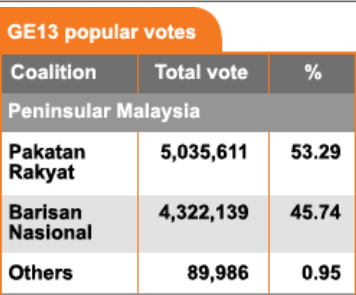
Malaysiakini’s figures from the Election Commission
So, it is quite preposterous for any police chief to suggest that they might arrest Pakatan leaders for ‘sedition’ for pointing this out.
Any such an arrest would in fact constitute the seditious act, as it would plainly undermine the wish of the popular majority of the state.

People have been threatened with ‘monitoring’ for wearing black!
Likewise, it is surely seditious for police to attempt to harass people for wearing black in protest over jerrymandering by an Electoral Commission, which was stripped of its independence by BN and now sits in the PM’s own offices with a primary duty to make sure BN wins for ever and ever and ever?
What a load of outrageous nonsense to start talking of arrests!
Protest is a democratic right
If BN want to make an expensive public show of running a civilised democracy with elections (and GE13 cost billions, if mainly in bribes) then they must needs put up with the other key trappings of democracy.
These include public demonstrations, protests, banners, free speech on public platforms and the right to wear black, yellow or what ever other form of apparel expresses the inner views of the individual.
People don’t usually give up their Saturday afternoons, unless there is something extremely important that they are concerned about, and governments are duty bound to listen if they do.
In return, the people are required to act in a restrained and non-disruptive manner that does not upset any of the rights of other fellow citizens. The orderly rally in a stadium on May 8th was a perfect example of just such a gathering.

Keep it up – BN could never get a crowd like this to support them!
There should be many more such public expressions of dissatisfaction to remind BN that they lost their legitimacy in this election and that reform of their gerrymandering devices is required immediately.  Contested seats should also be properly adjudicated.
Waste of energy?
People who are saying that more rallies and protests are a waste of time tend to be jaded observers of Malaysia’s recent past and the corruption of the country by Mahathir Mohamed.  They feel there is no point, since everything is a sham.
However, in practice they are asking people to give up on demanding their rights. And if the people do not stand up for themselves now, BN will move swiftly to oblige and with a huge sigh of relief.
If marchers stop turning out, their energy sapped by bleak cynicism, the losers in this election will go as far as they dare to try and ban any expression of the popular will by calling rallies ‘seditious’ or ‘unruly’ or whatever they like.  Some are already doing it.
Instead, BN should just get used to persistent if polite marches and rallies until they put their house in order and conduct clean and fair elections.
BN have lost their confidence, don’t let them regain it undeservedly
This decades old coalition has rightfully lost its confidence as a result of this election drubbing and the people should not permit BN to regain it or to tell themselves that they won the election after all.
BN did not win the election, they lost it fair and square and in the full glare of international publicity.
Some have fallen lamely back on talk of the US in 2000 being won by a minority vote, but that is nonsense too.  In 2000 it was sufficiently contentious that Bush was able to claim victory with .5% less of the popular vote.
In Malaysia in 2013 Najib gained 4% less of the popular vote than Anwar (after cheating) and 7.5% in Peninsular Malaysia.
Time moves on
So, giving up is not an option.
It is easy for people to become stuck in the past and to imagine that what happened before must always be.  In Europe the Berlin Wall was treated by many like a fact of life, as if it had always been there instead of just a few decades, like BN.
But in truth all empires collapse, everyone dies and nothing stays the same.  Therefore it is right that Malaysia’s young people should be active in determining a better future, rather than resigning themselves to more corruption and despotism.
Progress does happen when enough people put some effort into it.
And no one should under-estimate the sea-change that did take place in GE13, when a massive turnout swept away all BN’s efforts to manufacture the sort of wins they got away with in the past.
BN lost their legitimacy on May 5th
BN employed the full apparatus of the state into trying to ensure their win.  The media talked up their ‘victory’ unceasingly and refused to publicise Pakatan wins until they were ‘over-turned’ by numerous dubious re-counts.
The police were dragooned into escorting buses loaded with foreigners to election booths and state employees were bullied and pressured into voting for BN.
Yet, even so, to justify the figures the ballot box stuffers of the Election Commission were forced to announce an extraordinary and record breaking 80% turn out on the night, which next day they had to revise up to 85% to explain the numbers of votes that had apparently been forced into the various re-counts.
How could the turnout suddenly bounce up AFTER the election had been announced and yet other figures stay the same?
Think about it.  An 85% turnout in Malaysia?  This means that the extensively rural country with large numbers of very poor voters and around a million of its better off citizens unavailable abroad produced one of the highest turnouts in global election history!

42 seats more for BN, despite the less votes
Not even that explains the jiggery pokery behind the election commission’s figures, because even now their own figures still don’t tally.
The over all election vote, according to their separate figures was 27,403 more than the tally.
Does this mean 27,403 ‘spoilt votes’ on top of all the other outrageous jiggery poker?
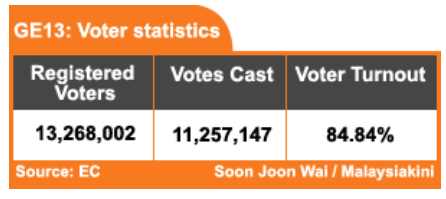
Figures revised after the event!
27,403 spoilt votes is a very large number.  Especially when you look at the narrow margin of so many of BN’s wins, a good number of which over-turned original Pakatan wins after a recount.
According to our calculations, 5,827 votes represent the total majority of BN’s 10 most narrow wins!
20,067 represents the total BN majority in the most marginal 20 seats.  Another 3 seats come to 6,303 total majority, meaning that the number of spoilt votes alone exceeds the margin by which BN ‘won’ the election.
Individually, there has already been considerable evidence that in numerous seats the ‘spoiled votes’ outnumbered the BN majority by a considerable amount.
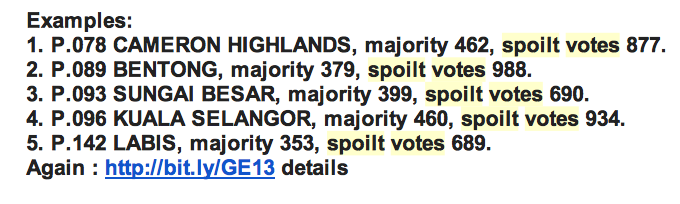
Analysis of BN’s election ‘win’ has only just begun, but the more that comes out the greater the smell
All this is virtually impossible for the shamed and embarrassed BN hierarchy to defend.  Who would want to be in their shoes day after day during the next Parliament when the majority leader (Anwar Ibrahim) challenges them on all these points and requires them to give way?
The problem BN faces is that time HAS ALREADY moved on and the crude practices that the likes of Mahathir could get away with as he sucked his country dry are no longer effective in a world of fast communications, video recorders and the internet all employed by an educated young population.
BN are already a museum piece, like North Korea.
Don’t let them re-group

Open secret – ‘hard man’ Muhyiddin has been waiting in the wings, to let the more popular Najib lead BN in the elections and then take over after blaming him for BN’s losses
The worst thing would be to allow the dreadful old has-beens of BN from the Mahathir era to think they can turn back the tide of that history and that all that is needed is a ‘crack-down’ under some kind of ‘hard chap’, like Muyhiddin Yassin.
There are people who think that by reversing what reforms have taken place in past years they can restore past ‘glories’.
Such small brains forget that the reforms were conceded under pressure in the first place and they imagine that Malaysia can return to be a backward museum of sham democracy where people like them can continue to enjoy ruling the roost.
But they need to realise that what small state dictators got away with in the Cold War era, when the eyes of the electronic age had yet to be switched on, is no longer possible.
In their hearts they admitted it when they accepted that they needed to keep the more moderate and tolerable Najib as their leader during the election, since only a small angry minority of voters prefer the aggressive Mr Muhyiddin.
The UMNO extremist hope now is to replace their front man, Najib, with their hard man Muhyiddin and then defy anyone to say they didn’t win the election fair and square!
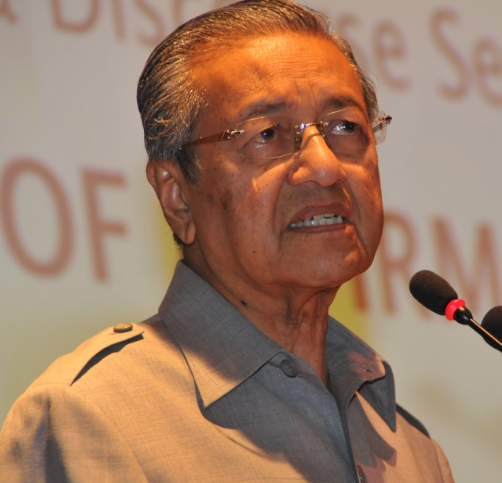
‘Has been’ without dignity – past politicians should go and do something else useful and not try to keep meddling.
This is too crude, too public and too playground ridiculous to wash on the world stage.
This weekend the British PM meets the Russian PM to decide on how to collaborate on sorting out Syria.
This is no longer the Cold War era and no government wants to be seen openly supporting a thug and BN cannot reverse this election with a crackdown and expect it to pass unnoticed as before.
BN have got to find a more dignified way out of this mess they are in and concessions, reform and gracious acceptance of the present popular opinion is the only route forward.
It may mean they will soon be out of power for some years.  But, it gives them the chance to come back.  If they ‘crack down’, go backwards, fight and oppress the majority then they will write themselves out of Malaysia’s future and blacken their names forever in Malaysia’s history.

From the archive of Sarawak Report 30 January, 2013

The Main Plot Is Against Najib!

The Main Plot Is Against Najib!

30 JAN 2013

As BN’s juddering coalition splutters and stutters towards the election, which it has been putting off but can no longer avoid, all the whispering is about revenge.
Najib is getting the blame in UMNO for the falling poll ratings and party plotters have been talking about how to deal with him and regain full control of Malaysia, which they once managed like their own personal vehicle.
Unlucky sight for BN on the road outside Kuching? After 50 years in government the collapsing UMNO vehicle is also   trying to keep on the road for its 13th General Election in the year 2013

A spent vehicle guided by a back-seat driver?
Front man for the election, but for the chop right after
Sarawak Report has already detailed an advanced plot to get rid of Taib by his closest insiders, but the real big story is that the same fate is being planned against Najib, also for the moment the election is over.
This means that Malaysians could end up voting for one leader, but end up with a completely different character just weeks afterwards.
That character would be the far less popular, hard man, Muhyiddin Yassin, the current deputy.
Behind the manoeuvrings is Malaysia’s very own back-seat driver, Mahithir Mohamad, who can’t accept his own retirement.
Mahathir’s back-seat driving is no secret in UMNO
And backing him are UMNO’s party hard-liners, nostalgic to bring back what they see as a Golden Age, when they controlled everything in Malaysia and could crack down hard on anyone who dared challenge that power.
Mahithir is running his own campaign plan”, explains one inside observer “and what he is telling people is that Najib is doing it all wrong, he is too soft.  He is saying Najib is too weak and Malaysia needs strong government”.
That there is such talk going round is widespread knowledge, as are the hard-line views of Mr Mahithir, who ruled Malaysia with an iron rod and removed the independence of the judiciary, press, police force and civil service in order to make sure his executive authority could not be challenged.
Malaysia’s former dictator kept his support by distributing favours, paid for by Sarawak and Sabah oil money, among his UMNO followers.
Ready to return with an iron fist. Mahathir is confident that Muhyiddin will bring Malaysia back to the way it was run
However, Mahithir was himself removed because this style of government had become plainly intolerable to Malaysians and UMNO needed to develop a different face to stay in power.
Badawi started the process and the resulting freedom saw the opposition doing much better in the 2008 elections.
But the UMNO hard-liners took this as their cue to claim Mahathir had been vindicated and it is well known that Mahathir himself was a prime mover behind the removal of Badawi shortly after that ‘disaster’ of democracy.
The tub-thumping Muyhiddin is their answer to Najib, who is seen as even weaker and more accommodating than Badawi, as he tries to show that Malaysia can reform and catch up with the world in terms of human rights and democracy.
Nothing annoyed the hard-liners more than the sight of the peaceful demonstration earlier this month, where hundreds of thousands dared turn out on the streets for the opposition, for once unmolested by the regime.  They would have preferred a crackdown and to hell with what the world thinks.
Simple plan
Opposition marchers risk a police bashing – BN marchers go for rice hand-outs from 1 Malaysia workers
The tensions have put Najib between a rock and a hard place.  He is indeed weak and still forced to indulge in the corrupt practices that have sustained BN for so many years.
After all, once you have started a career in bribery and corruption you can never escape it and the same rule applies to political parties.
The PM’s own counter-rally of a few thousand supporters looked pathetic, with the handouts of rice telling the full story of BN’s lamentable relationship with its followers.
But, Najib is also sufficiently modern to realise that he cannot put the cork back in the bottle in Malaysia and that change must come.  This was the reason why BN had to dump Mahathir in the first place and the reason behind the political tsunami in 2008.
It is obvious that to crack down again now would cause dangerous and intolerable pressures that would explode sooner not later.
However, this is exactly Mahithir’s plan, say observers.  He wants to bring Muhyiddin to power straight after the election is over, through a revolt at the long-postponed UMNO convention, which will have to take place almost immediately.
The former leader, who commands everyone’s ear in the party, because he was regarded in being so successful hanging on to power and making them rich, is trading off the growing fears that the momentum is sliding away from the party each day that the election is held off.
“Mahithir is talking to UMNO leaders and state leaderships one by one.  He was actively doing it at the recent UMNO General Assembly in November, when all the delegates were complaining about Najib’s leadership, especially the uncertainty over the election.  He has been saying to them ‘I have my misgivings with Najib as well, but we need to be united until the elections’ “, explains a separate observer.
Mahithir’s plan is simple, use Najib’s more moderate image, which is 20% more acceptable to the voting public than Muhyiddin’s, to get through the election and then substitute him.  Muhyiddin is far the more popular character with hard-line party insiders and will win their votes at the party convention.
Cheating again
It seems not to worry UMNO one bit that this is effectively setting out to cheat the electorate by advertising a more palatable, if weak leader and then substituting him with a hard-liner with an agenda to crack down on democracy and freedom.
But, then UMNO have been cheating and bribing the electorate for years.
If the widespread talk about replacing Najib in this way is untrue, then we await BN’s denials once more and look forward to hearing Mr Mahithir and Mr Muhyiddin pledge their loyal and undying support for their party leader and Prime Minister both before and after the election.
BN should meanwhile bear in mind that such plots predicate an election victory that is looking less certain every day that passes!

Tuesday, September 1, 2015

Eyeing my foreword message to the China Aid Alumni Association Malaysia Magazine

First of all let me take this opportunity in congratulating the committee members of the China Aid Alumni Association Malaysia for their inaugural publication of the CAAAM Magazine. It is indeed a very constructive and paramount effort in enhancing and distributing information amongst the alumni members and related stakeholders. Under the advice and guidance of the Economic and Commercial office of the Embassy of the People’s Republic of China in Malaysia, I am very confident that this magazine will be able to be successful and meet its objectives.

The new Central Leadership of the Communist Party of China with Xi Jinping as the General Secretary and President of the PRC has led the Party and the people of China in confronting the problems and challenges they face, to drive reform and opening up to a deeper level, to modernize the national governance system, and to marshal their enormous strength behind the Chinese Dream of the great rejuvenation of the Chinese Nation.

China is attracting growing attention worldwide. The world wants to know what changes are in progress in China and what impact they will have on the rest of the world. This magazine through the contribution of Alumni members who will have direct excess and experience in China can contribute to better understand in their own words the thoughts, views and direction of the CPC Central Committee and the President.

This magazine will definitely be very useful in responding to the rising international interest and to enhance the rest of the world’s understanding of the Chinese Government’s philosophy and its domestic and foreign policies.

We are very confident and positive that the Chinese Dream will benefit not only the people of China but also of other countries. The One Belt One Road initiative will not only bring prosperity to China but also along the 21st century maritime silk route. To achieve this goal we will need to share accurate information. We need to build the trust and good neighborly ties. Trust is the very foundation of both interpersonal and state to state relations. This magazine indeed will be one of the building blocks in disseminating the real, true and accurate information in creating and building the trust.

Sincerely yours,
Professor Datuk (Dr.) Naim Mohamad

Advisor China Aid Alumni Association Malaysia.

Sunday, August 30, 2015

Eyeing the Inaugural OCBC Cycle SEA Speedway Championship 2015

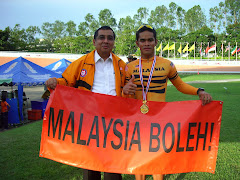
Malaysia underlined their status as the dominant force in cycling in this region after they won the inaugural OCBC Cycle Speedway SEA Championship in convincing fashion yesterday.
Powered by double SEA Games gold medallist Mohamed Hariff Saleh, the Malaysians led from start to finish in a three-way final race against Singapore and Brunei at the Sports Hub.
The quartet - comprising Hariff, Mohamed Saiful Anuar Aziz, Muhamad Adiq Husainie Othman and Muhammad Fauzan Ahmad Lutfi - clocked a time of 18min 44sec, far ahead of Singapore (22:44) and Brunei (22:54) to win the 10km race.
The teams were among the first to race in a new format. Two riders of each team would tackle the first 5km, followed by the next pair.
The team's time would be clocked when the last rider crossed the finish line.
If the Malaysians were unfamiliar with the format, they certainly did not show it, as they surged to about a minute ahead of the rest of the pack by the halfway mark.
"It seems like I can always do so well and win races here," joked Hariff, whose love affair with Singapore continues after his feats at the SEA Games.
Malaysia coach Sebastian Duclos felt that the race was won by adopting the right tactics.
He said: "We made sure that all of our riders kept up with one another, opening up a big gap right from the start, and staying focused throughout the race.
"I hope they can do well not just in the region but also in Asia."
There was drama surrounding the second- and third-place finishes. Entering the home stretch, Brunei's Abdul Hadrie Morsidi had crossed the finish line narrowly ahead of Singapore's Low Ji Wen.
But Brunei were later docked a 10-second penalty for going beyond the dismount line at the changeover, thereby lifting Singapore to second spot.
"It's probably the most tactical race I'd been in.
"But it's a big change from what we are used to and it's refreshing," Low said.
The two-day OCBC Cycle event concludes today with the mass-participation races - the 42km Sportive Ride and 23km The Straits Times Ride.

Saturday, August 29, 2015

Eyeing the present economic situation

Here is a broad summary:
Why the sell-off
·      While China’s growth story and plunging commodity prices may have been at the back of investors’ minds, China surprised markets in early August when it moved to devalue its yuan.
·      This fed fears that China was slowing faster than expected and triggered a vicious cycle of capital outflows.
·      The capital flight put downward pressure on emerging market (EM) currencies, resulting in weaker import demand and growth and spurring further outflows.
·      Investors are now worried that the global economy could plunge into a recession, as EM accounts for about half of global GDP.
·      This fear has caused equities to be sold off, led by EM and Asia and spreading to developed markets like the U.S., Europe and Japan.

Thursday, July 9, 2015

Eyeing Shad Saleem Faruqi's reflecting on the law - Honouring Constitutional Promises

The Federal Constitution grants to Sabah and Sarawak a number of iron-clad guarantees of their autonomy and special position.
THE “Borneoisation case” of Fung Fon Chen @ Bernard v Govt (2012) is slated for rehearing on July 23. It relates to alleged violations of Sabah and Sarawak’s special position in the Federal set-up.
When Sabah, Sarawak and Singapore joined hands with Malaya to constitute Malaysia, the significantly amended Federal Constitution granted them a number of iron-clad guarantees of their autonomy and special position.
Some in the peninsula feel that 52 years after Malaysia Day the special rights and privileges must give way to more unity and uniformity on such issues as right to travel, live and work throughout the Federa­tion. Many Sabahans and Sarawa­kians, on the other hand, lament that they have been shortchanged and that there is a distinct whittling down of the privileges promised to them in 1963.
Gleaning over existing literature, a list of the main complaints may run as follows:
Political control: The Federal Government dictates political outcomes. The Federal Government’s choice of Mentris Besar and Governors does not always reflect popular sentiments in these states. The declaration of emergency in Sarawak in 1966 and the dismissal of Chief Minister Stephen Kalong Ningkan indicate that state autonomy is rather frail. Interference by Federal politicians in Sabah’s politics in 1994 led to the replacement of popularly elected local leaders.
Expanding Federal jurisdiction: Labuan was ceded to the Federal Government in 1984. Water and tourism have been federalised. Federal trespass on Sabah and Sarawak’s right in relation to amendments to the Federal Consti­tution was highlighted in the landmark decision of Robert Linggi vs Government of Malaysia (2011).
Religion: At the time of the 1963 merger, there was no state religion in these two states. Islam is now the official religion of Sabah. Articles 161C and 161D, which imposed procedural restrictions on laws favouring Islam, were repealed in 1976. The seizure of Bibles and the judicial decision on the kalimah Allah issue have angered many Sabahans and Sarawa­kians.
Finances: There is an allegation that these states do not derive the kind of financial benefit they deserve as a result of their contribution to the national coffers from petroleum, hydroelectricity and tourism.
Immigration: The influx of illegal immigrants and the alleged ‘’naturalisation’’ of thousands of them are violations of Sabah and Sarawak’s right over immigration.
Parliamentary representation: In 1963 it was envisaged that the Borneo states and Singapore shall have no less than 33% of the Dewan Rakyat seats. The percentage has now dipped to 25%.
20-Point Agreement: Within Sabah there is considerable disquiet that some of the safeguards of the ‘’20 Points’’ have not been converted to law. A prominent complaint is that Borneoisation of public services in Sabah has not proceeded vigorously. It is alleged that insufficient protection is being given under Article 153 to natives of Borneo states.
Secession: In the light of the above, a movement has sprung up asking for Sabah to secede from the Federation. Legally speaking, our Constitution contains no provision for the secession of any state from the Federation. The disintegration of the Federal union is not contemplated by the Constitution. Any attempt at separation or incitement to secede will actually amount to treason and sedition under our criminal laws.
Even the 20-Point Agreement with Sabah explicitly states in para 7 that there is no right to secession.
But what about Singapore? Contrary to what is believed by some, Singapore did not unilaterally secede from Malaysia. Its “separation” was accomplished by several mutual acts between the Malaysian Federal Government and the state Government of Singapore.
Among these were the Inde­pendence of Singapore Agreement 1965 and the Constitution and Malaysia (Singapore Amendment) Act 1965. The latter made significant modifications to the 1957 Federal Constitution and the 1965 Malaysia Act and explicitly stated, “Parliament may by this Act allow Singapore to leave Malaysia”.
Self-determination: What about international law? One has to concede that the law of nations recognises the right of a people to self-determination. The law was born in an era of decolonisation and embraces the notion that people who have a common historical, ethnic, cultural, linguistic, religious, ideological, territorial or economic identity have a right to determine the political and legal status of their territory. They may set up a new State or choose to become part of another State.
In recent memory, Crimea (2014), Timor Leste (1995) and Bangladesh (1971) travelled down the painful, blood-soaked path of national liberation.
The principle of self-determination is recognised in Articles 1(2), 55, 73 and 76(b) of the United Nations Charter and in many other international documents. However, international law scholar Abdul Ghafur Hamid asserts that the legal right of self-determination applies primarily to colonised, trust and mandated territories: “The effect of linking self-determination to decolonisation seems to deny a general right to secession of groups within a State”.
I believe that despite some ambiguity in international law, the various regions (states, cantons, provinces) of a Federation do not have a legal right to walk away from the union. A unilateral act of separation is permissible in confederations like the European Union or Asean but not in a Federation united by a written, supreme Constitution which describes the territories of the Federation.
Leaders of Sabah and Sarawak must, therefore, disassociate themselves from all separatist movements. Instead they must negotiate with the Federal Government about their discontents.
In turn, Federal leaders must recognise that Sabah and Sarawak’s restiveness is real and must be addressed. The Federal Government must return to the meticulously negotiated compromises of 1963. It must balance the concern of equity with efficiency in inter-governmental financial relations.
It must strengthen institutional me­­c­h­anisms for regular, non-partisan dialogue between the centre and the states. If the root causes of dissent and disenchantment are addressed, this Federal union can survive the challenging decades ahead.
Shad Faruqi is Emeritus Professor of Law at UiTM. The views expressed are entirely the writer’s own.

Sunday, June 21, 2015

Eyeing Datuk Wong Chun Wai's "One for all, All for One" in Education.

Education is for all, it’s time we think of the bigger picture affecting all children.
MY colleague received a press statement sent by a very high-ranking official of a government department recently. It was personally written in English by the official and sent by WhatsApp to ensure it was speedily delivered.
The only snag was that his command of the language was so horrendous that my colleague had to suggest to him, politely, that he might want to stick to Bahasa Malaysia to ensure accurate reporting on our part. He got the message. A new version was eventual­ly sent.
Then, there are also the vice-chancellors of a few public universities who face the same language problem despite having spent much time in overseas universities to pursue their post-graduate studies.
We have also met Malaysian diplomats who cannot carry out a proper conversation in flawless English and we know some of them even shy away from social functions, which is a shame as this where they can pick up nuggets of information for their intelligence reports.
A few generations, yes, a few generations, are paying the price – unable to speak and write in proper English – because of our education system.
At best, they may have some semblance of communication English, but without the proper foundations in grammar, many are unable to even string a sentence together correctly.
Because English is just a subject, there is hardly any opportunity to use and practise the language on a regular and extensive basis within the school system.
That’s how low we have sunk. Forget about the occasional use of some Latin words to make the language more refined, if not, more classy. Getting through the basics is tough enough.
It is no surprise, therefore, that they really struggle when they reach tertiary level where much of the information is in English.
And even upon graduation, many employers are reluctant to hire them when they cannot function properly in an environment where the working language is English.
Controversial MP Datuk Bung Mokhtar became the butt of every joke on social media when he introduced a hashtag ­#earthquack for his postings on the earthquake situa­tion in his home state.
Well, we also can see that some of our Chinese politicians, from both sides of the political divide, struggle with English, judging by some of the postings they make on Facebook.
Every now and then, we have reports about bad English in an English examination paper. We have more or less gotten used to the fact that the English in many of our official websites are littered with mistakes.
It doesn’t seem to bother our politicians and decision makers one bit, as they will simply shrug off calls to allow English as a medium of instruction in our education system.
Why should they be worried as many of them are able to send off their children to boarding schools overseas at a young age? After all, the only ones that would bear the consequences would be the students in the rural areas.
The Ruler of Johor, Sultan Ibrahim Ibni Almarhum Sultan Iskandar, recently suggested that English be made a medium of instruction – he didn’t say make English THE medium of instruction.
The reality is that English, as a medium of instruction, is already available but it is restricted only to private and international schools, mostly in urban areas.
And despite the high fees charged, more urban parents are opting to send their children to such schools because they simply want their children to be proficient in this international language.
The urban-rural divide is accentuated because while children in the rural areas are sometimes teased for using English, it is perfectly normal for English to be used at home in middle-class Malaysia.
And with greater exposure to the language, the urban children do have an edge over those in the rural areas.
But it doesn’t have to be this way. As his Royal Highness the Sultan of Johor said, these politicians are using nationalism and race to champion communal rights and the Malay language at the expense of the English language.
They are doing so to protect their interests and political positions. Unfortunately, many seem to buy into their agendas.
We must also be clear that the lack of proficiency in English cuts across all races.
Many Chinese parents send their children to Chinese schools at the primary level because they want their children to be able to speak and write basic Chinese as they eye the growing economic power of China.
Many shy away from the national schools because there is a strong perception that these schools have turned more religious in character with a single race dominant in the overall attendance.
The national schools that many of us from my generation and earlier grew up in, where English was the medium of instruction, were different as all races were well represented.
But in our current situation, many Chinese parents also find that sending their children to the Chinese primary schools does not help their children have a good command of English either.
The English proficiency of the majority of Chinese teenagers, because of their background in Chinese schools, is just as bad as their counterparts in the rural schools.
They live in the Chinese world, watching Taiwanese and Hong Kong movies, with little interest in the real world.
Their worldview is shaped pretty one-­dimensionally and because of the environment they grew up in, they are unlikely to have real friends from those of other races.
Many of us in our 50s have been lucky – we were probably the last batch of the English-medium schools where we sat for the Malaysia Certificate of Education (MCE) and the Higher School Certificate (HSC) examinations.
The English-medium schools were neutral grounds as students of all races attended such schools and the best friendships were forged there.
We had real friends from all races because we were growing up together for at least 10 years in the schools. It was not functional friendship at work, but real bonding as we studied and played together.
I feel really sorry for many Malaysian kids who do not have friends outside their own race as they are not be able to shape their thinking in a more open way.
So, when a hot issue comes up in the country, especially those involving race and religion, they are not able to see things from another perspective.
Like many, I also worry about the future of Malaysia and our children, as the performance of our schools continues to falter. Beyond our concerns over language skills, we should be even more worried about the quality of our education.
Our ranking in Science and Mathematics is already reportedly low, although our politicians question its accuracy. But the reality is that many of us are no longer surprised by such trends.
Our politicians will continue to tell us that all is well and fine in our schools, and that we have little influence to change anything. Some of us may believe that to be so.
But if we really care for the country, we should not be afraid to propose radical changes for the sake of our future generations.
Education is for all and it is totally selfish if we only think of our own interests while the majority are stuck in a system which does not empower them to reach for the stars.

Eyeing Joceline Tan's "Death of Pakatan Rakyat"

Pakatan’s ‘seven-year itch’

The Penang Government will also become shaky if DAP carries out its threat to pull out of the Selangor administration.
SELANGOR Mentri Besar Azmin Ali was in Kelantan the day DAP declared that Pakatan Rakyat had ceased to exist.
It was quite ironic because there he was, looking so cosy and chummy with his Kelantan counterpart Datuk Ahmad Yakob while there was hue and cry elsewhere over the news.
The PKR deputy president is not the sort to wear his feelings on his sleeve and he seemed unruffled even as the rest of his party was behaving as though ants had invaded their pants.
Azmin was there for the signing ceremony to build homes for those displaced by the great floods last year and he had brought along several state exco members and civil servants. Selangor will build 60 houses at a cost of RM6mil in Kuala Krai, the Ground Zero of the Kelantan floods.
Was it his way of telling everyone that ties between PKR and PAS are on track even if DAP is pulling away?
The PKR deputy president has struggled to remain calm in the days following what some have termed as the “death of Pakatan”.
The jury is still out on whether Pakatan is really dead or still alive.
The joke is that Pakatan is going through the seven-year itch. It has been seven years since the three parties came together under the Pakatan umbrella and it seems like the threesome have begun to get antsy about their significant other.
PAS election director Datuk Mustafa Ali’s tongue-in-cheek take is that the coalition haspengsan (state of unconsciousness).
PKR’s admission that the coalition still exists but can no longer function formally suggests that Pakatan is in a wheelchair – it can still roll on but cannot walk or run.
Itchy, pengsan, in a wheelchair or whatever you call it, Pakatan is in a bad place at the moment. The coalition that won 52% of the popular vote in the general election and which regained Penang and Selangor with bigger mandates has squandered its opportunities and made a mockery of the new politics that they promised.
It is broken and that is perhaps the most accurate definition at this point in time.
PKR sources said their ketua umum Datuk Seri Anwar Ibrahim is furious that one party should decide on the status of a three-party coalition. He finds it “bloody arrogant” and has made it known to his party.
Well, he has a point there – this is a three party set-up and it needs at least two to decide.
Emotions are high and the administer for Anwar’s Chinese Facebook “Ah Hua Gor” had posted: “Thank you DAP for burying PR”.

Lee: ‘We are in uncharted waters’.
The DAP cybertroopers came down so hard on him and even put pictures of his children online that he had to apologise and take down the posting.
“The word from our topmost leadership is that there must be continued engagement even if we cannot work as a formal pact,” said PKR vice-president Shamsul Iskandar.”
DAP’s haste to issue Pakatan’s death certificate was aimed at appeasing its Chinese support base which has become very critical of PAS. It needs to distance itself from PAS or risk losing support in the next general election.
There is a very strange situation going on. PAS has severed ties with DAP and DAP is dead against PAS’ Islamic agenda but both do not want to leave. They are waiting for each other to get out.
As a result, DAP has resorted to pressuring PKR to choose between the two parties. But PKR feels that it does not have to choose because it can work with both parties.
Behind the scenes, Selangor DAP is threatening a pullout of sorts from the Selangor government if PKR does not choose.
Selangor DAP chairman Tony Pua has been the most hawkish of the lot. He has been quoted in the Chinese media demanding that Azmin choose between DAP and PAS.
Recently, Chinese media reports quoting sources from Selangor DAP claimed that if Azmin did not choose, DAP state exco members would resign after Hari Raya. The DAP had done the same thing to force Tan Sri Khalid Ibrahim to resign.
The anonymous DAP leader also demanded that Azmin sack the PAS state exco members who want to ban alcohol sales in Selangor.
Softer approach
Azmin did not retaliate. Instead, he used the personal touch to reach out to DAP leaders when he met them in Parliament a few days later. He approached the MPs personally, asked for their understanding and urged them not to make such public statements.

Shamsul: ‘Continued engagement goes on'.
“The three parties in Selangor have to respect the wishes of the voters who gave them such a big mandate. People are fed-up with the politicking, we need to find a way to manage things until the term runs out. Dissolving the state assembly is an option of last resort,” said DAP’s Jelutong MP Jeff Ooi who is also a columnist in Sin Chew Daily.
However, Ooi did not rule out a “final fallout” taking place between DAP and PAS.
The blame game is still going on but the fact is that all three parties contributed to the crisis.
PKR sparked it off with the controversial Kajang Move. PAS regarded it as a disrespectful unilateral decision and refused to support Dr Wan Azizah for the Mentri Besar post.
Then PAS moved to introduce hudud law in Kelantan which erupted in a war of words with DAP. The PAS muktamar decision to severe ties with DAP was the catalyst to DAP jumping the gun to declare that Pakatan is finished.
It was a domino effect phenomenon, and it is unclear whether the last domino has fallen yet.
The perception is that PKR has the most to lose if DAP pulls out from the Selangor government.
But PKR will not take it lying down, it can also pull out from Penang and put Chief Minister Lim Guan Eng’s government in jeo­pardy.
In Penang, DAP has 19 out of 40 state seats, PKR has 10, PAS 1 and Umno 10. The Penang government can still survive as a single-party government but it will be a government standing on one leg.
It will be a very weak government that is unable to pass laws in the state assembly or make major decisions. It will also become a near mono-ethnic government that will be highly unstable.
And if the Selangor DAP state exco members carry out their threat to quit, PKR could do the same to Lim’s state exco in Penang. In the end, both governments could come tumbling down.

Ooi: Final fallout ahead for DAP and PAS.
“We are in uncharted waters, we need to exercise restraint. A tit-for-tat game is not good for anyone,” said former Kajang assemblyman Lee Chin Cheh.
The political chatter is that DAP’s aggression in Selangor is also connected to DAP wanting a bigger slice of the pie in the state such as appointments to important state GLCs and other government posts. There is also a rumour going around that a Selangor DAP leader wants to become the Mayor of Petaling Jaya.
DAP is trying to change its Chinese image, hence, its attempt to recruit pretty Malay girls and high-profile Malay names. It is trying to recruit credible Malays whom it can put as candidates in the next general election.
New multiracial flavour
The party is also trying to woo the PAS moderates who lost in the recent party PAS election. It will be quite a catch if big names like Mohamed Sabu or Dr Mujahid Yusof Rawa sign up.
It has managed to recruit national laureate Datuk Samad Said while law professor Dr Aziz Bari, who contested but lost in the general election on a PKR ticket, may soon join DAP.
DAP does not want to depend on PAS or PKR for the multiracial flavour if it wins well again.
That is the DAP plan for the next general election and the day when Selangor has its first DAP Mentri Besar may not be far off.
But the “Pakatan is dead” pronouncement has made things terribly awkward for the three parties.
Will DAP state exco members still attend the weekly state exco meetings with their PAS counterparts? Is it going to be business as usual or will it be like a funeral?
The Penang government has begun to use the term Kerajaan Negeri Rakyat Pulau Pinang. Will DAP politicians in Selangor follow suit or will it continue to labour under the old name? It is so easy to say die, but the devil lives on in the details.
DAP leaders have also begun promoting the notion of a new political realignment.
Veteran Lim Kit Siang said the new coalition will comprise political forces of like-minded people with the interests of the people at heart.
Hmmm ... wasn’t that what they said when they set up Pakatan Rakyat?
Everyone had settled in with their popcorn and soft drinks to watch the Mahathir-Najib action movie.
But that was so yesterday – the audience has moved on to a more gripping thriller called the “Death of Pakatan Rakyat”.

Monday, May 11, 2015

Eyeing Dr M’s ethical years and BMF case by Tunku Abdul Aziz


EXCESSES: The unresolved BMF scandal looms large even while some seek answers to the 1MDB puzzle In researching my subject I came across an article that I wrote for the Australian Journal of Public Administration in December 1999, titled “Malaysia Incorporated: Ethics on Trial”, as well as a paper that I delivered to the International Institute of International Affairs, Chatham House, London on March 19-20, 2001 titled “Has Reform Revived the Miracle?” I struck some historical nugget of information about Tun Dr Mahathir Mohamad’s outrageously questionable ventures that many may have forgotten. I believe it is important for our youth to know something about the Dr Mahathir years. For example, the country’s oldest English language broadsheet, the New Straits Times, felt constrained to editorialise on Sept 23, 1978, no doubt more in sorrow than in anger, “there was once a time when a Malaysian could indulge in a little smile of condescension when stories of corruption in developing countries, other countries of course, were entirely justified: virtually every aspect of administration was clean, abuse of power unheard of, departmental morale was high, public confidence was vibrant. For whatever reason, the present conditions have called forth a litany of exhortation against corruption”. The nostalgic “there was once a time” was a pointed reference to the administration of the first prime minister, Tunku Abdul Rahman, to whom service before self was an important personal creed. Soon after Dr Mahathir took over the reins of government, a horrendous financial scandal engulfed Bank Bumiputra Berhad, incorporated in 1978 as the vehicle to launch the Malays into business. Touted as the “flagship” of the New Economic Policy, by 1988 it had assets worth more than US$15 billion (RM54 billion). Moving aggressively into overseas ventures, lending recklessly to politically well-connected companies and individuals, many of them possessed neither the capacity nor the intention of repaying the loans. The bank shifted large sums of money to its wholly-owned subsidiary, Bumiputra Malaysia Finance Limited (BMF), which in turn lent in total close to US$1 billion to a Hong Kong $2 company called Plessey Investment Limited and another, Carrian Investment Limited. George Tan, the man behind Carrian, within months of the BMF money going through the books, ran his company into the ground. Billions disappeared into thin air. In Malaysia a committee of inquiry was set up, headed by Datuk Ahmad Nordin, the fearless auditor general whose report stopped just short of naming senior members of government who had profited from the loan disbursements. Nordin recommended that criminal proceedings be instituted against those involved. No such action took place in Malaysia. In Hong Kong, criminal action was taken under the law against the crooks as soon as the scandal broke. Scapegoats or, to use the modern expression, fall guys were quickly identified and “persuaded” to fall on their swords. One of them was Lorrain Osman, the then chairman of BMF, who went into exile in England. In Malaysia, Dr Mahathir’s studied indifference served to reinforce suspicions of high-level complicity. The most damning indictment was the claim made by a Hong Kong lawyer that BMF and its parent, Bank Bumiputra Malaysia Berhad, accepted an arrangement based on incestuous relations between senior politicians and bank officers and that his client simply carried out orders (Clad 1989:53). This, as to be expected, was never proven in Malaysia. I have highlighted just one incident that I was prepared to treat in a spirit of charity as an aberration. A few years ago, before he died, I met Lorrain in the company of my old friend, Datuk Yunus Rais, in London and over a meal asked Lorrain who was behind the Carrian affair? He asked me whether I thought that he alone could have made the decision to move billions of US dollars without instructions from “high above”? I had the answer I had been after all those years. In a more open and accountable society, the wrongdoers would not only have been dragged through the courts, but the government, too, would have been brought down. We need to find all the answers to the 1Malaysia Development Berhad (1MDB) financial conundrum, and the prime minister has done the right thing by getting the auditor general to investigate the operations of the company. Before we deliver a guilty verdict, let us exhaust all investigations and other avenues before we call anyone to account. We will, in our current climate of openness, get a lot faster to the bottom of 1MDB’s shortcomings, if indeed there are problems, than we got out of the investigations into financial and other excesses during the lost ethical years when Dr Mahathir was prime minister. (In the writing of this article, I have used information from the works of Gale, B; Clad; Jomo, K.S.; Hussein, S.A.; and the ‘New Straits Times’ Sept 23, 1978. I am indebted to them all.) The writer is a director of International Institute of Public Ethics and board member of the Malaysian Anti-Corruption Commission.